Ruciane-Nida (0.0 km) · Guzianka Lock (0.5 km) · Wejsuny (4.4 km) · Onufryjewo (6.8 km) · Wierzba – ferry crossing (13.9 km) · Mikołajki (18.6 km) · Iznota (24.5 km) · Wygryny (31.4 km) · Ruciane-Nida (34.6 km)
The Bełdany Loop was established in the Piska Primeval Forest, one of the largest forest complexes in Poland. The route also passes through picturesque Masurian villages and two well-known tourist destinations: Mikołajki and Ruciane-Nida. An unquestionable attraction of the surrounding area is the Polish Konik horse breeding farm. The animals are gentle and can often be spotted here.
We set out on our trip from the center of Ruciane-Nida. First, we head down Dworcowa Street toward Wejsuny, then turn onto Mazurska Street. We pass the remains of a technical monument unique in the region—Richard Anders’s sawmill. We reach the intersection of Cicha Street and Guzianka Street. Here, the trail markers appear.
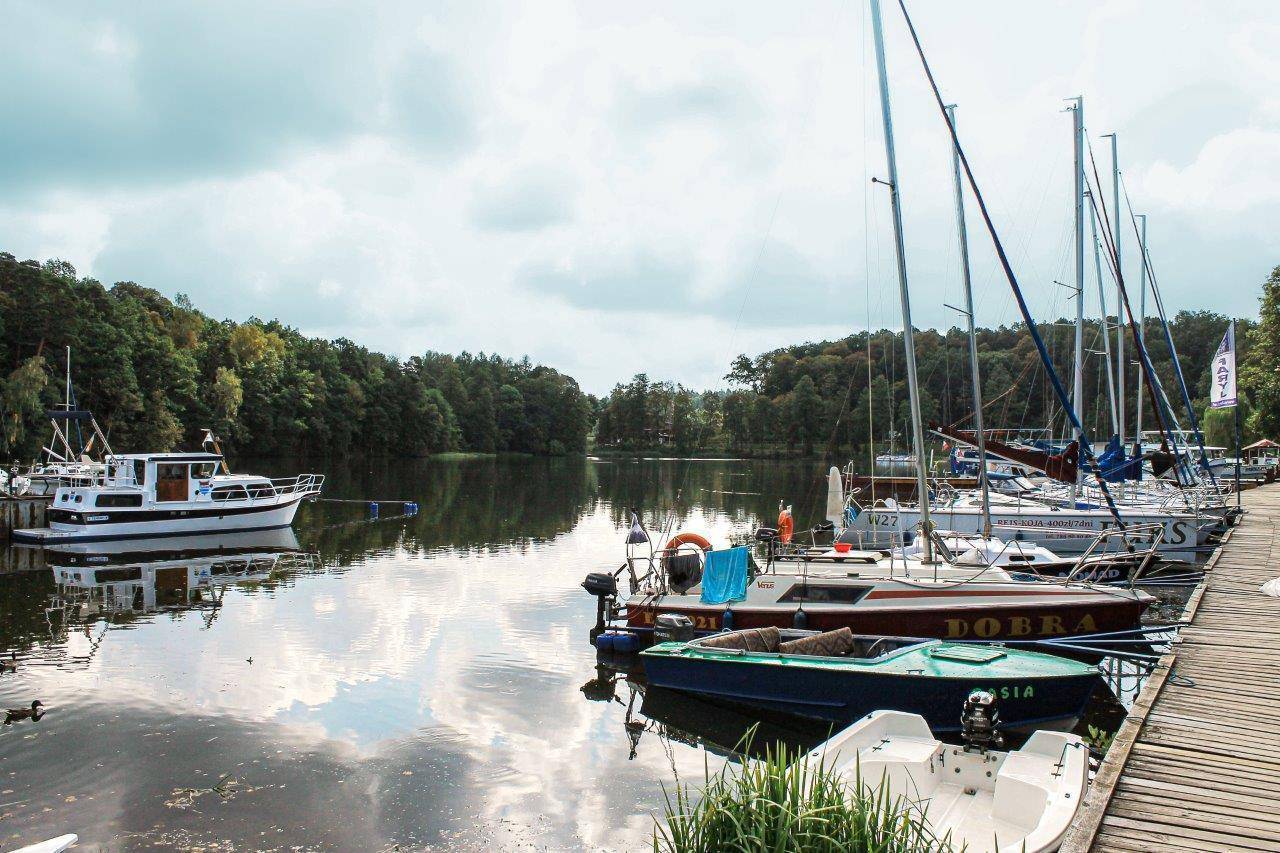
We continue north, passing the Guzianka I and II locks, which connect Lake Bełdany and Lake Guzianka Mała. The difference in water level between the two bodies of water is 2 meters. The first, wooden lock was built here in 1879. Twenty years later, its chamber was rebuilt using bricks and stones. To improve water transportation—since up to 15,000 vessels pass through this major route during the navigation season—the Guzianka II lock was put into service in 2020. Near the locks, a tower bunker dating from the early 20th century, equipped with machine-gun emplacements, has been preserved as part of the fortifications of the Masurian Lakes Position.
We drive to Wejsuny along an asphalt road through the forest. In the village, next to the elementary school, there is a public sandy beach with a pier on Lake Wejsunek.
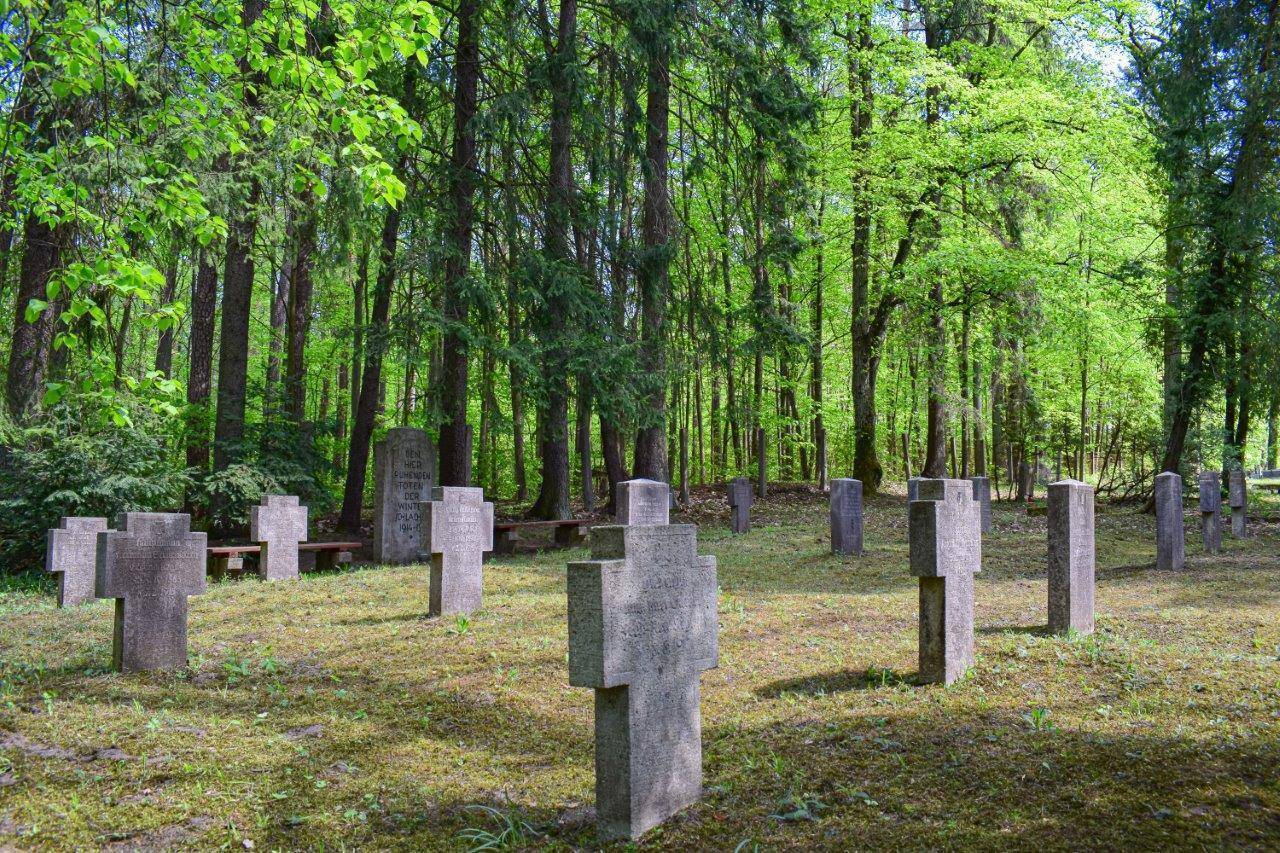
Wejsuny is a former fishing village and is now a tourist destination. Numerous 19th-century wooden cottages have been preserved here. The main attraction is the Regional Museum, established in the 1970s. It houses a collection of Masurian handicrafts, primarily from the 19th century. An important local landmark is the Neo-Gothic Evangelical church from 1898, located not far from the route. Next to the church stands a monument commemorating those who fell in World War I.
Following the trail markers, turn left in the center of the village. Continuing on, you’ll pass the Warnołty Lake Nature Reserve on your right. Although it’s located near the trail, it’s barely visible from the route. The lake is shallow and largely overgrown with aquatic vegetation, featuring extensive underwater meadows. The riparian rushes provide a suitable habitat for numerous species of waterfowl. The reserve protects rare species of peatland and marsh vegetation.
We pass the village of Onufryjewo on our left. It was the first settlement founded by the Filipons, who belonged to the Old Believer Orthodox community. They were persecuted in Russia and therefore began settling in East Prussia in the 19th century. The settlement’s name comes from Onufry Yakoblew, the community leader who brought them here.
As we enter the forest, we reach the gate leading to the Polish Academy of Sciences (PAN) Research Station in Popielno. Beyond the gate lies the Polish Konik horse breeding area. We travel a few meters along a surface made of movable rollers. This is a safety measure to prevent the animals from leaving the designated area.
Before reaching the ferry in Wierzba after traveling about 6 km through the forest, we can still take a detour to Popielno (2 km to the east). From the paved road leading to the village, there’s a magnificent view of the hilly countryside. In Popielno, there is a small beach and a marina on Lake Śniardwy—a great place to relax. During the summer, you may encounter Polish Konik horses grazing along the trail; they are bred at the local Polish Academy of Sciences (PAN) Research Station. The animals are accustomed to the presence of tourists.
We return to the trail and head toward Wierzba. The local ferry crossing across Lake Bełdany (360 m long) is undoubtedly a tourist attraction. It is also the only ferry on the Great Masurian Lakes Trail.
The initial section of the trail on the other side of the lake may be sandy in places. On the right, we’ll see a small forest cemetery belonging to nearby Kulinów and the Śniardwy forester’s lodge. Before we reach the first buildings of Mikołajki, we’ll pass a boulder with the inscription “Miłosz,” which commemorates the place where a young man by that name died.
We turn left toward Iznota (at this point, we can veer off the route and extend the trip to explore Mikołajki). We continue along the trail for 5.5 km on a well-maintained gravel road through the Piska Primeval Forest. We reach an asphalt road and cross the bridge over the Krutynia River. Before the bridge, on the right, there is a bar and a kayak launch site.
Iznota is a village steeped in legends about Prussian gods and chieftains. The Galindia resort and amusement park are located here.
Past Iznota, we cover another long stretch through the forest. A gravel road in good condition leads us to Wygryn. Along the way, we pass small but very picturesque forest lakes and the village of Kamień, home to a resort beautifully situated on the Bełdany River (you can plan a break here). It’s also worth noting the charming little chapel standing by the route, which appeared in the closing credits of Andrzej Wajda’s film *Pan Tadeusz*.
In Wygryny, we cross a bridge over the Nidka River, then pass through the village, including characteristic 19th-century Masurian red-brick houses and the building of a former school.
The final section of the route, nearly 3 km long, leads through the forest to Ruciane-Nida. Before completing the loop, on the left, we pass a bunker located near the road, which was part of the Masurian Lakes Defense Line. There are informational signs next to it.
The trail is marked in red.
Note! There is a ferry crossing in Wierzba along the route, which operates from June through September. The loop trail is accessible only during this period. Before reaching Wierzba, it’s worth taking a detour to visit the Polish Academy of Sciences (PAN) Research Station in Popielno, which features a Natural History Museum and a Polish Konik horse breeding center, and to relax by Poland’s largest lake—Śniardwy.
Ruciane-Nida lies on one of the two railway lines connecting Olsztyn with Ełk. Regional trains and several long-distance trains stop here.
Road access is provided by National Road No. 58, which runs from Olsztynek through Szczytno, Ruciane-Nida, and Pisz, among other towns.
Mikołajki
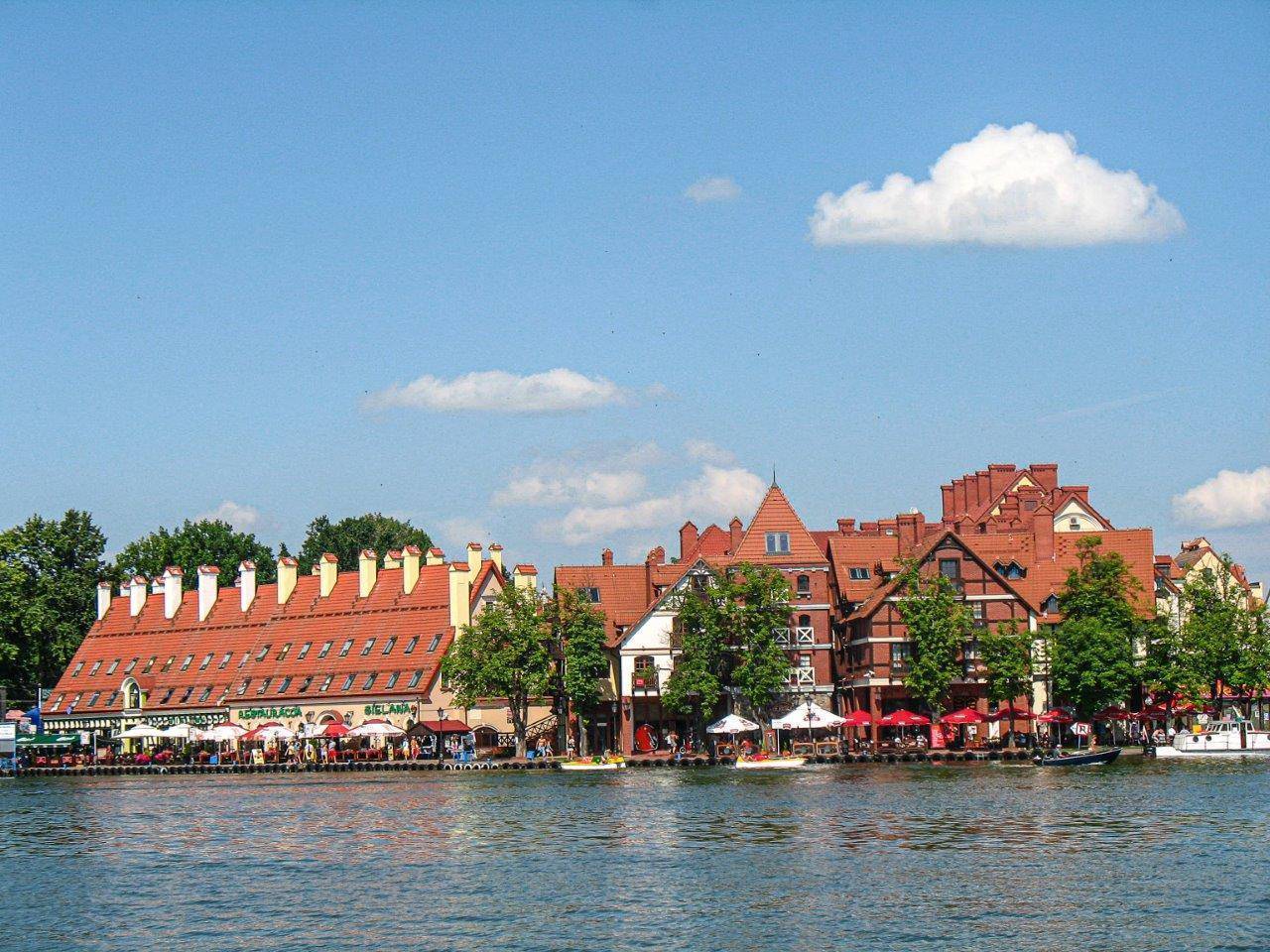
Mikołajki is often called the Pearl of Masuria and the Venice of the North. Although it is a small town with 4,000 residents, it is one of the region’s main tourist centers. The municipality offers as many as 8,000 lodging options! Mikołajki is situated on the Great Masurian Lakes route, at its narrowest point—the isthmus connecting Lakes Mikołajskie and Tałty. This is where the waterways from Giżycko and Ryn intersect with those leading to Ruciane-Nida and Pisz.
The first recorded mention of the village under the name Niklasdorf dates back to 1444. The name derives from St. Nicholas, the patron saint of sailors and waterways. From the Middle Ages through the 19th century, it was a fishing village. Its residents engaged in fishing, weaving, logging, and timber rafting.
The town’s most important landmark is the 19th-century Evangelical church with its tall, slender clock tower. Its interior is characterized, as befits a Protestant church, by simplicity and elegance. When visiting the church, it is worth noting the portraits of local pastors: Andrzej Kowalewski and Albert Pescarovius, who served as pastor for 71 years and died at the age of 106. Adjacent to the church is the Museum of the Polish Reformation. The antique prints collected here serve as a reminder of the faith of the Mazurs of old. The museum also promotes knowledge about famous Poles who were Protestants. Winter sports enthusiasts can view skis donated by Adam Małysz and Piotr Żyła.
On Wolności Square—the town’s main square, which serves as the market square—stands a fountain featuring King Sielaw. The townhouses surrounding the square represent various architectural styles. The most impressive building is the former town hall from 1888 (now a hotel).
An interesting historical site is the Jewish cemetery on Dybowska Street, established in 1881. It is one of the few surviving Jewish cemeteries in Masuria. Several dozen tombstones with inscriptions in Hebrew and German have survived to the present day.
Less well-known but equally interesting are two bunkers (two-story blockhouses) built before World War I to protect the bridge (now reserved for pedestrian traffic). They are part of a fortification system known as the Masurian Lakes Position. Their purpose was to secure the crossings to the western shore against attacks from the east.
Mikołajki is also home to the Hydrological and Meteorological Station of the Institute of Meteorology and Water Management, which was the first to record radioactive contamination following the Chernobyl reactor accident in 1986. The station conducts synoptic and radiological measurements and carries out research on solar radiation.
On the opposite shore of Lake Mikołajskie is the Research Station of the Institute of Experimental Biology of the Polish Academy of Sciences, which conducts scientific research in the field of hydrobiology and organizes educational workshops for a wide audience.
Tourists are drawn to the famous Mikołajsk promenade—a 1.3-kilometer-long pedestrian walkway that is also the longest mooring pier in Masuria. In 2021, the promenade was modernized and widened. One of the town’s main attractions is a passenger boat cruise, and the most popular route is a trip to Lake Śniardwy. During the summer season, you can see the “King of Sielawa” swaying by the road bridge—a metal fish about 2 meters long that references the legend of the origin of Mikołajki’s coat of arms. The best vantage point is the tower of St. Nicholas Church, which is open to tourists during the summer. From there, you can see not only the town but also Poland’s largest lake—Lake Śniardwy.
Łuknajno Lake Nature Reserve
Europe’s largest strict ornithological reserve (covering approximately 710 ha), which protects one of the largest refuges for the mute swan. Hundreds of these birds stay here in the summer and fall. A total of over 175 bird species have been observed in the reserve, including 95 nesting species. Among others, you can see the white-tailed eagle, marsh harrier, gray heron, cormorant, and black tern here, as well as coots, grebes, and spot-billed and red-crested pochards on the water. In 1977, the lake was designated a biosphere reserve by UNESCO, and in 1978, it was added to the list of international reserves under the RAMSAR Convention, which protects wetlands. Three observation towers have been erected around the lake for observing waterfowl and marsh birds.
Ruciane-Nida
A town surrounded by the Piska Primeval Forest, situated on Lakes Nidzkie and Guzianka Wielka, along the Great Masurian Lakes route. The Nidka River flows through it. As early as after World War I, it was an important destination on the tourist map of East Prussia. Thanks to its location on a navigable waterway, it remains a popular destination for tourists today.
The historic Guzianka lock (now Guzianka I), built in 1879 and still in operation, connects the town and Lake Nidzkie with the rest of the Great Masurian Lakes route. Some sources indicate that a wooden chamber lock in Guzianka already existed as early as 1775. It would therefore likely have been similar to its “contemporaries” on the Tałcki and Łuczański canals.
In the past, there were two separate settlements, founded in the 17th century: Ruciane and Nida. It was not until 1966 that they merged into a single town.
The village of Ruciane on Lake Guzianka Wielka began to develop rapidly around 1900, when Richard Anders began expanding a sawmill there.
By 1945, it was one of the largest and most modern sawmills in Germany. Unfortunately, the historic complex fell into disrepair. The following structures have survived to this day: the sawmill hall, the boiler room, the workshop, the blacksmith’s shop, the carpentry shop, the water tower, the stable, the carriage house, the warehouses, and the administrative building. In the vicinity of the plant, on Dworcowa Street, stands Richard Anders’s villa, which belonged to him at the time, and on Mazurska Street—the home of his son, Georg Anders.
The sawmill grounds were taken over by the municipality, which plans to revitalize the site. Plans call for the creation of a promenade with a marina, a service area for water, hiking, and cycling tourism along the Masurian Cycling Loop, and recreational areas by the water.
The town’s close connection to the Piska Forest is evidenced not only by the remnants of the sawmill industry but also by the seed extraction plant located on the exit road leading toward Pisz. It was built between 1890 and 1892 and was the largest facility of its kind in East Prussia (it is currently the largest wooden building in the province). The seed extraction plant is still in operation today and supplies seeds from pine cones. In a single day, 30 kg of seeds are extracted from 2,700 kg of pine cones.
On Słowiańska Street stands the so-called “Borejszówka”—a wooden house from the 1950s with a roof shaped like an upside-down boat. It was once home to Jerzy Borejsza, a communist activist, journalist, and publisher, who made the place famous by hosting prominent figures there, including Józef Cyrankiewicz and the Chilean poet Pablo Neruda.
The town features two natural monuments: a pine tree over 200 years old on Wczasów Avenue and an oak tree over 300 years old on Dworcowa Street. There is also a historic cemetery, beautifully situated in the forest on Cicha Street.
A historic fortification complex from the turn of the 19th and 20th centuries has also been preserved; it is part of the Masurian Lakes Defense Line, known as the Ruciane Defense Node. The main defensive positions were: the Kula Group near the Kula Bridge, the Szymonka Group, the Zielony Gaj Group, the Mikołajki Group, the Guzianka Group, and the Ruciane-Nida Group. In total, nearly 30 structures were built. Among the interesting features are the concrete-reinforced open firing positions for machine guns and artillery. Machine guns were considered experimental at the time. By 1902, three concrete towers with machine gun emplacements had been built in Ruciane and Guzianka. One of them, built in 1900, is located directly next to the Guzianka I lock. It is open to visitors during the summer season. The other two towers can be seen near the road and railroad bridges on the Nida Canal.
Popielno
In this village, located on the Popielno Peninsula, there is a Research Station of the Polish Academy of Sciences dedicated to the breeding and conservation of the Polish Konik breed, which is directly descended from the now-extinct forest horses, the tarpans, that once roamed what is now Poland. At the station, visitors can also see European beavers and cervids. Another attraction is the Natural History Museum, which houses not only exhibits related to the station’s activities and history but also a collection of vintage carriages, buggies, and sleighs.
Galindia
Galindia is the name of a resort complex with an adjacent amusement park. The complex draws on the culture and customs of the Galindians, a Baltic tribe that inhabited the area of present-day Masuria until around the 12th century. Unusual attractions await tourists here: dinners in caves, boat trips, a ritual stone circle, demon dungeons, a maze, and stories about the history of the region’s ancient inhabitants.