Orneta (0.0 km) • Godkowo (16.0 km) • Surowe (17.6 km) • Pasłęk (36.7 km) • Słobity (52.3 km) • Gładysze (63.5 km) • Osetnik (69.2 km) • Chwalęcin (72.6 km) • Orneta (83.6 km)
This route is recommended for both history buffs and cyclists who enjoy leisurely rides through picturesque landscapes. Along the way, you’ll pass many historical sites, including the ruins of the palace in Słobity and the restored palace in Gładysze (both of which once belonged to the Dohn family). The route also includes the historic towns of Orneta and Pasłęk, as well as one of Warmia’s most famous places of worship—the Sanctuary of the Passion of Christ, established at the Church of the Exaltation of the Holy Cross in Chwalęcin
We start from the Gothic town hall in Orneta. Following Zamkowa Street, we reach Provincial Road No. 513 and head toward Pasłęk. We ride to Drwęcznie along a dedicated bike path. In Godków, we can visit the wooden Orthodox church dedicated to the Protection of the Mother of God.
TheRelocation of the Orthodox Church
The Orthodox church dedicated to the Protection of the Mother of God, which currently stands in Godków, originally came from the village of Kupna in the Podkarpacie region. The remains of the historic church were moved here and reconstructed in 2012.
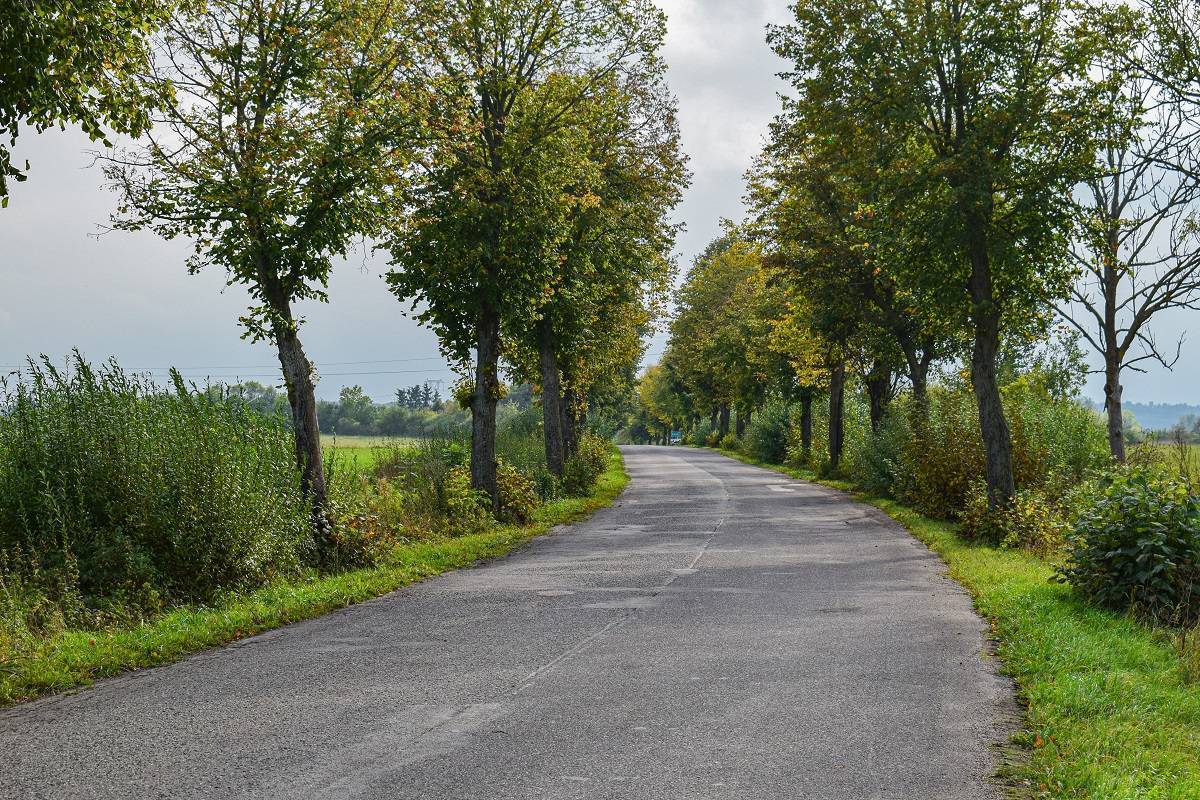
From Godków, we follow the signpost toward Niebrzydowo. We ride along local roads to the village of Surowe, with some sections lined by rows of trees. The terrain here is fairly flat. In Skowrony, we pass the Church of the Assumption of the Blessed Virgin Mary (formerly Evangelical), built in the mid-14th century on the site of a Prussian stronghold. We turn right and continue along a deteriorated asphalt road through Nawty and Gruzajny. Upon reaching the village of Gradki, we turn right again. Staying on the asphalt all the way, we cross the bridge over the Sale River and head toward Surowy. The route continues along Provincial Road No. 527 through Rogajny to Pasłęk, but at this point it’s worth taking a detour of less than 3 km to Kwitajny to see the Baroque palace and park complex. Once you reach Pasłęk, head west toward Zamkowa Street. Ride down the even cobblestone road onto Provincial Road No. 505 toward Frombork. Then, past Pasłęk, turn toward the village of Robity and continue straight to Łukszt. At the end of the village, at the fork in the road, turn left toward the north. Passing the Stępniewo Forest District and the settlement of Górski Las, we reach the settlement of Słobity-Stacja. Staying on the paved road, we turn right and then left. We arrive at the center of the village, which features a large pond and a shelter where you can rest. While in Słobity, it’s worth seeing two local landmarks: the ruins of the Dohn family palace, which can be seen from the road, and the 19th-century Neo-Gothic former Evangelical church with a tall tower, which you reach via a cobblestone road leading uphill. From the center of Słobity, continue straight ahead to the “Wilczeta 6” signpost. At this point, turn left and then pass through Karwiny. Beyond the forest, the route leads through farmland. You’ll reach Wilcząt. A cross stands in the center of the village. We turn right onto Provincial Road No. 509 toward Gładysz. Before the village, in the forest on the left side of the road, stands the Dohn family mausoleum. Gładysz also belonged to this powerful family. The local palace has been beautifully restored. We continue along Provincial Road No. 509, then turn off it toward Osetnik. Here, at the bend, it’s worth taking a left detour. Right by the road stand the ruins of an 18th-century church, destroyed during World War II. A cross still hangs on one of the walls.
Another town worth visiting is Chwalęcin, a small village with a very famous shrine. From here, we return to Orneta via Augustyny and then along a very wide paved road through Krzykały.
You can explore the route on a road bike, touring bike, hybrid bike, or mountain bike.
Railroad stations are located in Orneta (on the Olsztyn–Braniewo line) and in Pasłęk (on the Olsztyn–Elbląg line).
Pasłęk
A small town that received its town charter in 1297. The first settlers were Dutch, brought in to drain the local lands. For this reason, the town was long known as Holland (Polish: Holad Pruski; German: Preußisch Holland). Pasłęk boasts many charming historic sites, preserved among modern buildings. The former Teutonic Knights’ castle now houses the town hall and a cultural center. Next to it stands the 14th-century Gothic Church of St. Bartholomew, featuring a predominantly Baroque interior. An interesting fact is that an underground tunnel connecting the castle to the church has been discovered. To this day, Pasłęk’s Old Town is surrounded by defensive walls approximately 1,200 meters long and 8 meters high, built in 1320. These are the longest medieval walls in the Warmian-Masurian Voivodeship. Two former city gates have also survived: Młyńska Gate and Kamienna Gate. Pasłęk’s town hall also dates back to the 14th century; in 1945, it was 80% destroyed by Soviet troops. The municipal buildings adjacent to the town hall were also damaged. After the war, these historic structures were rebuilt. It is also worth visiting the historic Renaissance cemetery chapel from 1598. Since the 1960s, it has been used jointly by Evangelicals and Orthodox Christians; it is therefore both the Orthodox Church of St. Onuphrius and the Evangelical Church of the Augsburg Confession of St. George. After 1812, Jews began settling in Pasłęk. A remnant of this community is the very well-preserved Jewish cemetery. The graves date from the second half of the 19th century, and the oldest matzeva dates from 1860. An attractive place to relax within the city limits is the Ecological Park—a charming wooded area with a swimming area on the lake, walking trails, and spots for camping and barbecuing.
Kwitajny
The town’s main attraction is a palace and park complex consisting of a palace (built in 1740 and rebuilt between 1840 and 1850 in the Neo-Renaissance style), a 19th-century orangery, and a small park with ponds surrounding the buildings. The estate belonged to the Dönhoff family, one of the most prominent Prussian families. In 1939, it was owned by Countess Marion Dönhoff, who later became a journalist, an advocate for Polish-German reconciliation, and the author of books on East Prussia.
Słobity
The village still features the ruins of the Dohn family’s Mannerist palace, built between 1622 and 1624 and significantly expanded between 1696 and 1723. It was a beautiful residence with a two-story ballroom and royal apartments, and one of the five palaces in East Prussia where the monarch stayed during his travels throughout the country. In March 1945, the palace was burned down. Only the majestic outer walls of the main building have survived. Słobity served as the main seat of the family, which over the centuries expanded its estates to include properties in Bielica, Gładysze, Kamieniec, Marków, Karwiny, Karwity, Katy, and Sasiny, as well as in Morag and Prakwice. While in Słobity, it is also worth visiting the 19th-century Neo-Gothic former Evangelical church with its tall tower. A plaque dedicated to the villagers who died during World War I is affixed to its outer wall. Interestingly, the plaque depicts trees and forest animals, including birds, squirrels, and a snail.
Chwalęcin
This is one of eight well-known pilgrimage sites in Warmia. The late Baroque Church of the Exaltation of the Holy Cross in Chwalęcin, 11-130 Orneta, tel. 660 169 540, www.facebook.com/chwalecin; the village mayor, who lives across the street, holds the key to the sanctuary’s gates. The church, with its Neoclassical façade, stands by the road in the center of the village. Originally, there was a chapel here housing the “black crucifix,” famous for its miraculous powers, which was discovered in the 16th century in a forest near the Wałsha River. During the plague epidemic of 1709, the Warmian chapter vowed to build a church on this site. Its construction was completed in 1728. The appearance of the church and the gate added in the 19th century is reminiscent of the sanctuary in Święta Lipka. The interior features stunning late-Baroque polychrome decoration depicting 14 scenes from the legend of the Holy Cross. In addition, the rich late-Baroque decor of high artistic value has been preserved, including Rococo confessionals and an 18th-century pulpit. A Gothic “black crucifix” from around 1400, considered miraculous, is located in the main altar.