Lidzbark Warmiński (0.0 km) • Koniewo (6.0 km) • Wielochowo (8.9 km) • Lidzbark Warmiński (11.3 km)
The route passes through the area around Lidzbark Warmiński, often referred to as one of the pearls of Warmia. The town is the former capital of this region. The local castle of the bishops of Warmia, a majestic building with cloisters, is sometimes called the “Wawel of the North.” The former summer residence of the bishops—the Krasicki Orangery—is also a delight to behold. The route offers stunning views, and along the way you can plan a break at the developed beach in Wielochowo.
The route begins on Polna Street, in the northeastern part of the city. Initially, we head north, passing St. Andrew Bobola Church and the Biblical Garden along the way. Beyond Lidzbark Warmiński, a morainic landscape of a flat plateau stretches out, characterized by gentle hills. We ride along an asphalt road toward Koniew, then turn left onto a paved gravel road, following the signpost. This is the only unpaved section of the route before Wielochowo. Upon reaching Wielochowo, we join the Green Velo trail and turn left. As we leave the town, we pass the municipal swimming area with its beach, piers, and food stands. We reach Provincial Road No. 511 and enter the bike path, which begins at the illuminated route. From here, we return to Lidzbark Warmiński via the designated bike path of the Green Velo trail.
The route is mostly paved, in very good condition, and runs through gently rolling terrain without any steep descents or ascents. It is also very well marked as a yellow bike trail. The initial section to Koniewo (6 km) coincides with the blue trail, while the final stage from Wielochowo to Lidzbark Warmiński (2.3 km) follows the red bike trail. This last section is also part of the Green Velo trail.
Lidzbark Warmiński
The historic capital of Warmia, over 600 years old, is situated in the heart of the region at the confluence of the Łyna River and its tributary, the Symsarna, on the border between the Masurian Lake District and the Sępopolska Lowlands. This charming town delights visitors with its picturesque river bends, green spaces, and numerous historic sites. The most valuable of these is the imposing, four-winged Gothic castle, known as the Pearl of the North. Its construction was begun in 1350 by Jan of Meissen, Bishop of Warmia. The former seat of the bishops consists of a well-preserved 14th-century main castle and an outer bailey. Prominent politicians and cultural figures stayed here; Warmian regional assemblies were held here, and courts sat here. Today, the castle houses the Warmian Museum at pl. Zamkowy 1, 11-100 Lidzbark Warmiński, tel. 89 767 21 11, https://lidzbark.muzeum.olsztyn.pl. Inside, the following are particularly noteworthy: the Great Refectory with a gallery of Warmian bishops, an exhibition showcasing the castle’s famous residents, as well as collections of sacred art ranging from the Gothic to the Baroque periods and Polish paintings from the late 19th and 20th centuries. At the bishop’s behest, a Classicist summer palace—the Krasicki Orangery—was also built; it has now been beautifully restored and renamed the Orangery of Culture. Exhibitions, concerts, and other artistic events are held here.
An important monument of religious architecture is the Gothic parish church of Sts. Peter and Paul, located at 1 Kościelny Square, 11-100 Lidzbark Warmiński, tel. 89 767 23 15, www.parafialidzbark.pl. Originally built in 1315, it burned down twice. Construction of the present-day church began in the second half of the 14th century. The main altar dates from 1912–1915. Another 14th-century landmark is the High Gate (Wysoka Brama), located at 2 Wysoka Brama St., 11-100 Lidzbark Warmiński, adjacent to which stand two Neo-Renaissance townhouses. Near the High Gate stands a wooden Orthodox church, which was built between 1821 and 1823 as an Evangelical church. Today, Lidzbark Warmiński is known for its rich calendar of cultural events, including the Festival of Humor and Satire, jazz concerts, and culinary festivals.
A new attraction will be the spa infrastructure, as the city is applying for spa status and building brine graduation towers. The Symsarny Valley Spa Park is colloquially known as the “Lidzbark Serpentines.” It owes this name to the meandering river. While strolling through the park, you can discover historical landmarks—Okartowa Hill, from which the town’s water supply was drawn as early as the Middle Ages; the remains of the fortifications of the Lidzbark Triangle; a former execution site; a monument to the heroes of the 1870–1871 war; and a Russian-Prussian defensive position from 1807. Those interested can also stimulate their senses of smell, hearing, and touch by walking along the sensory trail. The park is the perfect place for walking, jogging, Nordic walking, or cycling.
Lidzbark Warmiński is also home to Termy Warmińskie—the only facility of its kind in the Warmian-Masurian Voivodeship. It’s a perfect place for rest and relaxation, both for those who actively participate in sports and for those who simply want a break from everyday life. The facility consists of a sports section and a recreational section, where visitors can enjoy a range of water attractions. These include swimming pools, a multimedia slide with light and sound effects, hydromassage jets, water jets, and a sauna area. Along the bike route, there is also an interesting Biblical Garden next to St. Andrew Bobola Church at 34a Polna St., 11-100 Lidzbark Warmiński, www.parafia-lidzbark.pl/pages/ogrod-biblijny. The garden covers approximately 900 m². It features architectural structures alluding to biblical scenes and is home to about a thousand plants of several dozen species, whose names can be found in the Holy Scriptures.
Wielochowo
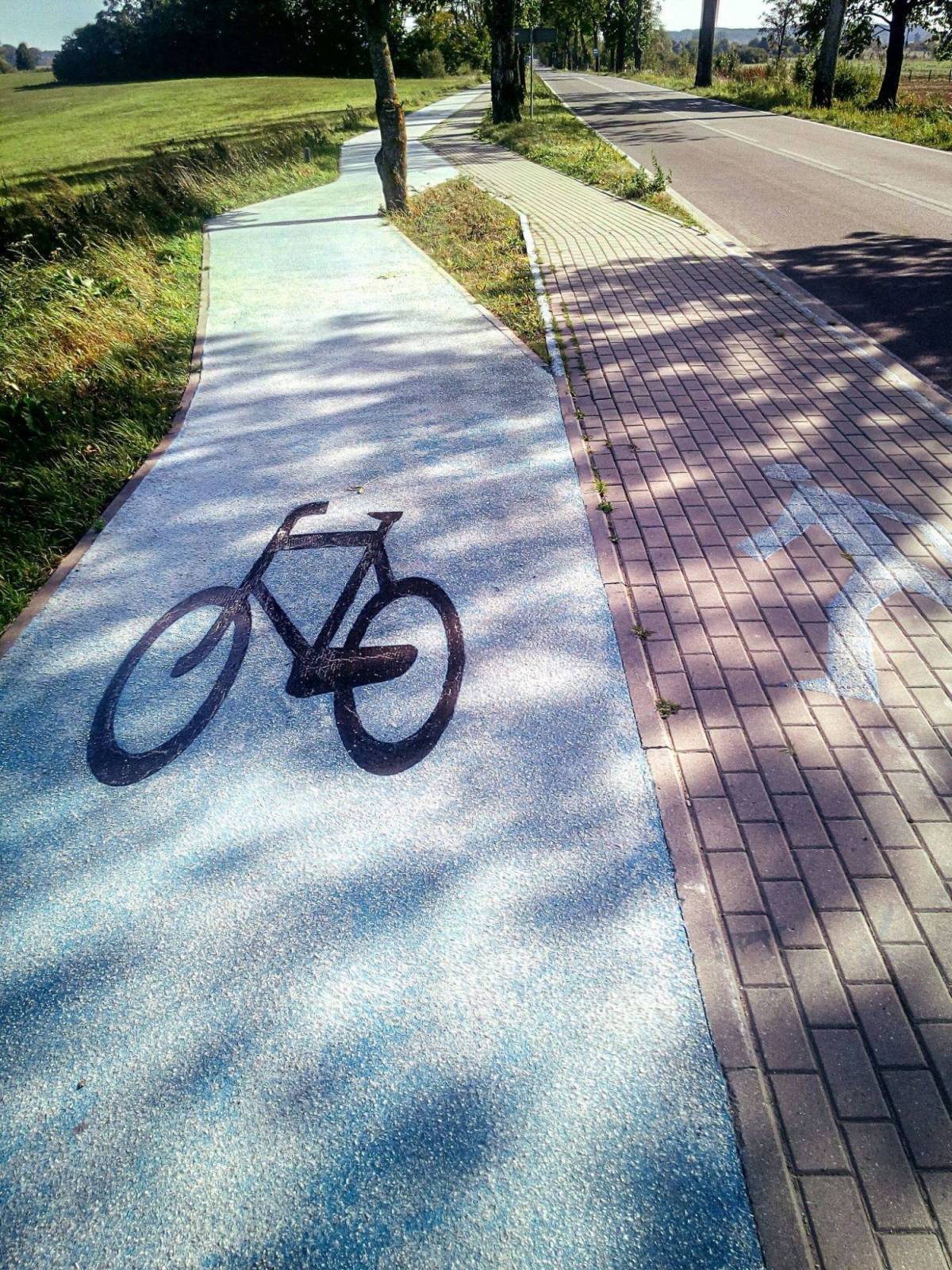
The town has become famous for its glowing bike path. The approximately 100-meter-long section of the path runs along Provincial Road No. 511. It has a blue surface that emits a dark blue light at night. This improves visibility and, consequently, the safety of cyclists. The path glows thanks to phosphors—special synthetic substances that charge using daylight and then release the stored energy. In winter, the glow is slightly weaker. We recommend planning your ride for the evening. Wielochowo also has a beach with a swimming area.
Nicolaus Copernicus in Lidzbark Warmiński
Nicolaus Copernicus was from Warmia! The astronomer’s ties to the city were particularly strong between 1503 and 1509. In 1503, Copernicus arrived in Warmia after studying in Italy, as a young doctor of canon law and a physician. Initially, he cared for the health of his uncle, Łukasz Watzenrode, Bishop of Warmia. While staying in the capital of Warmia, he gained a deeper understanding of the bishop’s political strategies regarding the cathedral chapter, the Prussian estates (the regional assemblies of the time), the Teutonic Order, and the Polish court. He became an advisor to the bishop. In his spare time, Copernicus pursued his own interests and made use of the bishops’ extensive library. It was in Lidzbark Warmiński that he developed the first outline of his heliocentric theory. Later, as an envoy and as a physician, he supported successive bishops.